Localization teams are under more pressure than ever. Content volumes keep climbing, budgets stay flat, and stakeholders expect both speed and flawless quality in every market. The choice between MTPE (machine translation post-editing) and traditional human translation often determines whether a project delivers strong ROI or quietly drains resources.
The good news? The decision doesn’t have to feel like a gamble. When you match the method to the content type, you can cut costs by 40–60% on the right projects while still hitting the accuracy levels your audience and regulators demand. Here’s a clear, side-by-side breakdown of cost, speed, and accuracy—plus practical guidance on when each approach makes the most sense.
Cost: Where the Biggest Savings Show Up
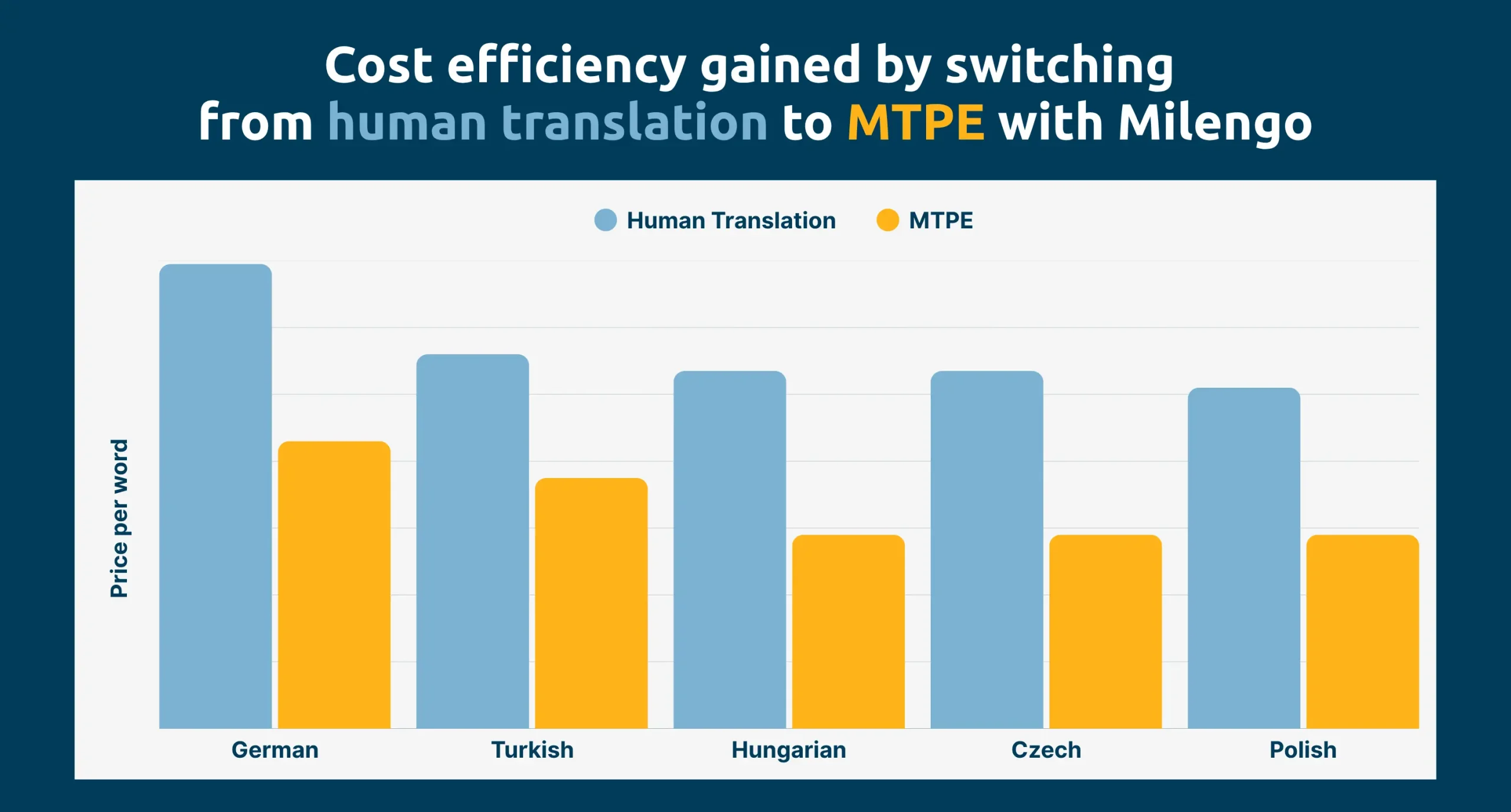
Human translation remains the premium option, typically priced at $0.15–$0.30 per word, with specialized or rare-language work pushing higher. MTPE flips the economics: post-editors work from a high-quality neural draft instead of starting from scratch, bringing rates down to $0.05–$0.15 per word—often 50–75% of full human pricing.
Take a real-world 100,000-word technical documentation project (English to German, Spanish, and French). Pure human translation might run $20,000. The same scope with professional MTPE lands around $10,000—straight 50% savings—while still delivering production-ready output. Light MTPE for internal-only materials can push savings to 60–75%. Industry reports confirm these figures hold across enterprise programs: hybrid workflows routinely deliver 40–60% lower overall localization spend without measurable drops in customer satisfaction for informational content.
Speed: How Fast You Actually Reach Market
Time-to-market is often the hidden multiplier in localization ROI. Professional human translators average 2,000–2,500 words per day. With MTPE, experienced post-editors routinely hit 4,000–5,000 words per day—delivering projects 50–70% faster overall.
A comprehensive 2026 study analyzing 90 million words across 879 linguists found MTPE 66% faster on average than from-scratch human work, though gains vary by language pair (English–French showed +130% productivity; English–Swedish was closer to neutral). For high-volume technical manuals or support libraries, that speed advantage means weeks shaved off launch timelines and faster updates in every market.
Accuracy and AI Translation Quality: The Nuance Factor
Raw machine translation has improved dramatically, but it still needs human oversight for most business use. MTPE bridges the gap: modern neural engines handle repetitive technical language extremely well, and a skilled editor corrects tone, context, and subtle errors that automated metrics miss.
Blind evaluations show MTPE reaching 90–98% of human quality on technical and informational content when paired with domain-specific glossaries and style guides. Creative, brand-critical, or legally sensitive material is a different story—human translators maintain cultural nuance, emotional tone, and legal precision that even the best post-editing workflows can’t fully replicate yet. Hybrid approaches in some studies have matched or slightly exceeded pure human output at 60% of the cost, but only when the content plays to the strengths of both.
Quick Decision Guide: Match the Method to the Content
Stop applying one-size-fits-all pricing. Use this framework to align investment with business risk and impact.
| Content Type | Cost Priority | Speed Priority | Accuracy Needs | Recommended Approach | Expected ROI Impact |
|---|---|---|---|---|---|
| Daily internal comms / FAQs | High | High | Functional clarity | MTPE (light) | 60–75% savings + fastest turnaround |
| Technical manuals / product specs | High | Medium | High consistency | MTPE (full) | 40–60% savings, near-human quality |
| Marketing product descriptions | Medium | High | Brand-aligned tone | MTPE | 50% savings with strong conversions |
| Brand slogans / campaigns | Low | Medium | Full creative nuance | Human Translation | Protects revenue & reputation |
| Legal contracts / compliance docs | Low | Low | Zero tolerance for error | Human Translation | Avoids regulatory risk |
| Customer support knowledge base | High | High | Clear, searchable | MTPE | Faster updates, lower support costs |
Making the Smart Choice for Your ROI
The organizations seeing the highest returns aren’t choosing between MTPE and human translation—they’re using both strategically. Run every brief through the matrix above, apply private or secure engines where data sensitivity matters, and reserve full human expertise for the 20–30% of content that truly moves the needle on revenue or risk.
When done right, MTPE doesn’t replace human translators; it multiplies their impact. You get more languages covered, faster market entry, and budget left over for higher-value creative work.
At Artlangs Translation, teams have refined exactly these balanced workflows across more than 230 language pairs for years—handling everything from video localization and short-drama subtitle adaptation to game localization, multi-language audiobook dubbing, and large-scale data annotation transcription. The result is a proven track record of delivering measurable ROI while keeping the quality and compliance standards enterprise clients require. When your next localization brief lands, the numbers will tell you exactly where MTPE stretches your budget furthest and where human translation remains the only safe investment.