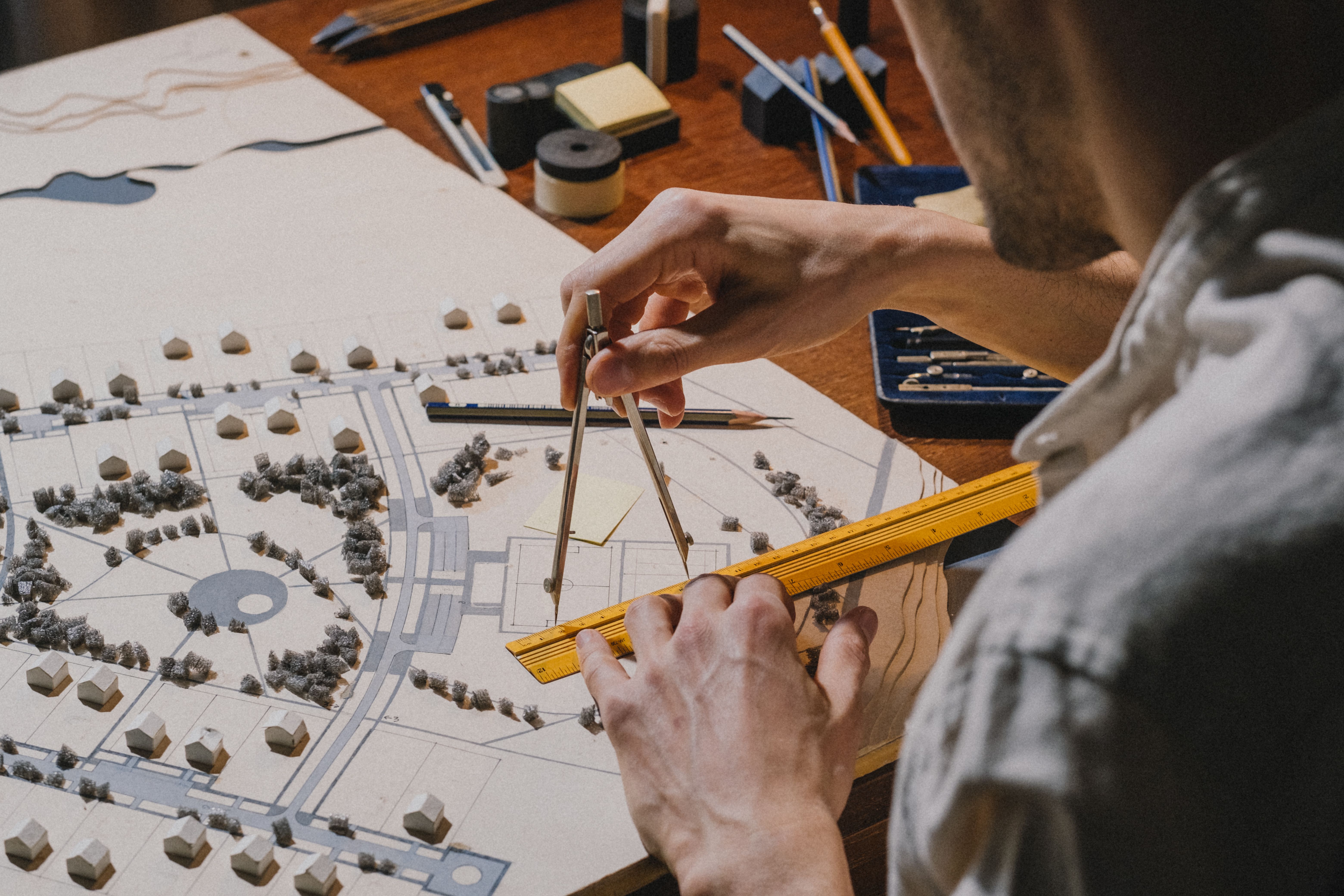
A German supplier receives a DWG package for a precision gearbox housing. The English callouts look clean. Once opened on the shop floor, several dimension leaders sit on top of centerlines, material notes have stretched into overlapping blocks, and a positional tolerance frame no longer aligns with its datum. Production pauses while the file is sent back for fixes. This pattern repeats across automotive, aerospace, heavy equipment, and industrial automation supply chains whenever drawings move between languages and CAD environments.
Engineering drawings are not ordinary documents. Text exists as entities—single-line TEXT, MTEXT with formatting codes, block attributes in title blocks, dimension text bound to geometry—distributed across named layers that also hold hatch patterns, construction lines, and centerlines. Treating the file like a Word document or exporting everything to PDF for extraction almost always breaks those associations. Layers collapse onto Layer 0, leaders drift, and revision clouds lose meaning. Native handling inside the CAD environment, or tightly controlled round-tripping that preserves object properties and handles, is the only reliable path to an editable, plot-ready deliverable.
Text expansion compounds the problem. English technical labels routinely grow 25–35 percent when rendered into German or Russian; Romance languages commonly need 15–30 percent more space. A compact English note such as “Valve” becomes “Absperrventil.” In a dense title block or beside a tight leader, the extra characters either overflow available space or sit directly on geometry. Professional desktop publishing is not cosmetic cleanup after translation. It is an engineering adjustment of text styles, leader lengths, note placement, and controlled line breaks while the underlying geometry remains untouched. Teams that treat the drawing as a constrained design problem rather than a word-processing task keep the visual hierarchy intact.
Font compatibility adds another failure mode. Older drawings frequently rely on SHX shape fonts or specialized TrueType technical faces that lack glyphs for the target script. Missing fonts produce question marks, boxes, or substituted metrics that change wrapping and spacing. Asian scripts introduce different challenges around vertical metrics and CJK glyph support; Cyrillic and Arabic create their own gaps. Planned font mapping or substitution, performed before or during the localization pass and validated across the full sheet set, prevents the garbling that forces later rework. Different software versions and encoding mismatches (UTF-8 versus older regional code pages) produce the same results if not anticipated.
The highest-stakes risks sit in specialized mechanical terminology. Geometric dimensioning and tolerancing symbols follow either ASME Y14.5 or the ISO GPS system. The two share many graphical elements yet differ in default principles—the envelope principle versus the independence principle—and in how material condition modifiers and datum reference frames are interpreted. A linguistically correct but contextually wrong rendering of a positional tolerance, profile of a surface, or MMC/LMC modifier can produce parts that pass the supplier’s inspection and fail the buyer’s. Material designations (AISI, DIN, JIS, GB codes) and heat-treatment notes must map accurately to the receiving region’s standards. Documented cases include rework of hundreds of structural components after a mistranslated welding annotation and multi-hundred-thousand-dollar daily stoppages when operators followed incorrect fit or torque instructions. Industry reviews have linked a substantial share of engineering failures and rework costs—running into the tens of billions annually across capital equipment and construction—to documentation discrepancies that include translation errors.
These barriers are global. Japanese and European OEMs typically work under ISO GPS conventions; North American aerospace, defense, and automotive primes often mandate ASME Y14.5. Drawings that cross those boundaries without explicit standard invocation or careful equivalence mapping introduce ambiguity at every subsequent manufacturing and inspection step. DXF files, valued for portability, remain especially fragile: dynamic blocks, external references, plot settings, and dimension styles frequently degrade during conversion. Layer naming conventions themselves can act as machine keys in scripts and filters; casual translation of layer names can break downstream automation even when the visual content looks correct.
Quality control therefore requires more than linguistic competence. Successful workflows combine mechanical literacy—the ability to read a drawing the way a manufacturing engineer does—with production-grade DTP that respects layer structure, entity types, and spatial constraints. Controlled terminology databases calibrated to the client’s standards, bilingual engineering review of critical callouts, and final CAD validation against the source geometry form the practical barrier that separates usable files from costly failures. Generic extraction tools and generalist translation pipelines cannot replicate this combination at scale.
Artlangs Translation has built its engineering drawing and technical documentation practice around exactly these requirements. With more than twenty years of specialized service experience, support for over 230 languages, and a network of more than 20,000 professional translators and subject-matter specialists, the company delivers native-format DWG and DXF localization that preserves layers, fonts, attributes, and geometric associations. Its track record spans mechanical assembly drawings, GD&T-heavy packages, and multi-language engineering documentation for global manufacturers. Beyond pure translation, Artlangs maintains capabilities in video localization, short-drama subtitle localization, game localization, multilingual dubbing for short dramas and audiobooks, and large-scale multilingual data annotation and transcription—allowing consistent terminology and quality standards across an entire product documentation ecosystem.