Inventors chasing global patent protection soon discover a brutal reality: one sloppy phrase in the translation of an invention patent application can shrink claims, trigger rejections, or wipe out rights in an entire country. The abstract and background sections are where the damage usually starts. These aren’t simple summaries—they’re the legal foundation that examiners, competitors, and courts will pick apart for years.
Take the abstract. Offices like the USPTO and EPO strictly limit it to about 150 words. The CNIPA in China caps the Chinese version at roughly 300 characters. It has to spell out the technical field, the exact problem solved, the inventive step, and key uses—without any fluffy language or sneaky claim-like wording such as “the invention relates to.” A translator who doesn’t fully understand the underlying tech might turn a precise description into something vague. Examiners then issue office actions demanding clarification, adding months of delay and thousands in extra legal fees. Worse, the wrong wording can let competitors argue lack of novelty down the road.
The background section is even trickier because every jurisdiction reads it differently. In the United States, anything that sounds like an admission of prior art can be locked in as “applicant-admitted prior art” that you can never argue around later. European examiners, on the other hand, want a crisp explanation of what’s wrong with existing solutions so they can see exactly why your invention advances the field. Get the tone wrong in translation and your own background suddenly weakens your case instead of strengthening it. Real filings have collapsed over less. One U.S. patent died because an Italian-to-English translation changed “semi-liquid” to “half-liquid” in the claims—a single word that shifted the entire scope and made the patent unenforceable.
Deadlines make the situation unforgiving. PCT national-phase entries close at 30 or 31 months from the priority date in most major offices. Miss that window because translations aren’t ready and the invention is exposed forever in that market. Even if you file on time, poor wording can still alter claim scope, violate enablement requirements, or fail formal rules such as single-sentence claims in the U.S. or the mandatory “characterized in that” structure in China. The result? Rejections, amendments that narrow protection, or expensive appeals.
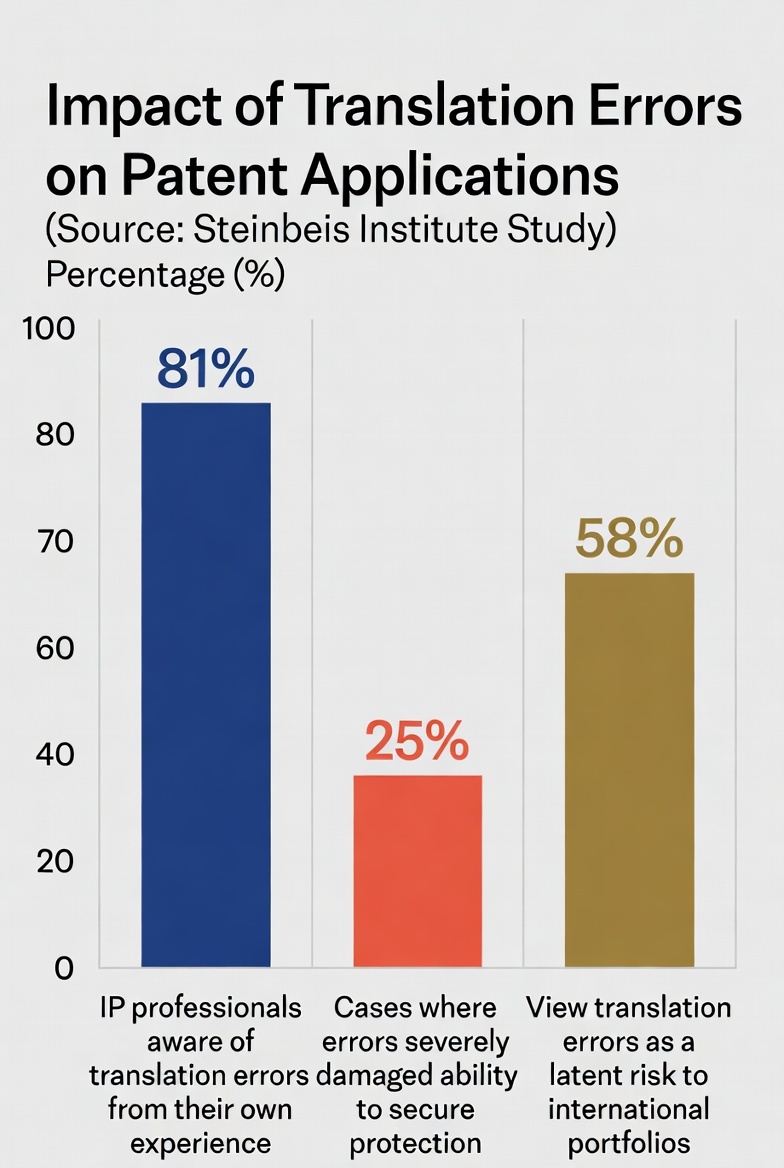
These aren’t rare horror stories. A Steinbeis Institute study asked IP professionals about their real-world experience with patent translations. About 81% had personally seen translation errors in applications. More than one in four knew cases where those mistakes severely damaged the applicant’s ability to secure protection. And 58% called translation errors a hidden threat to entire international patent portfolios.
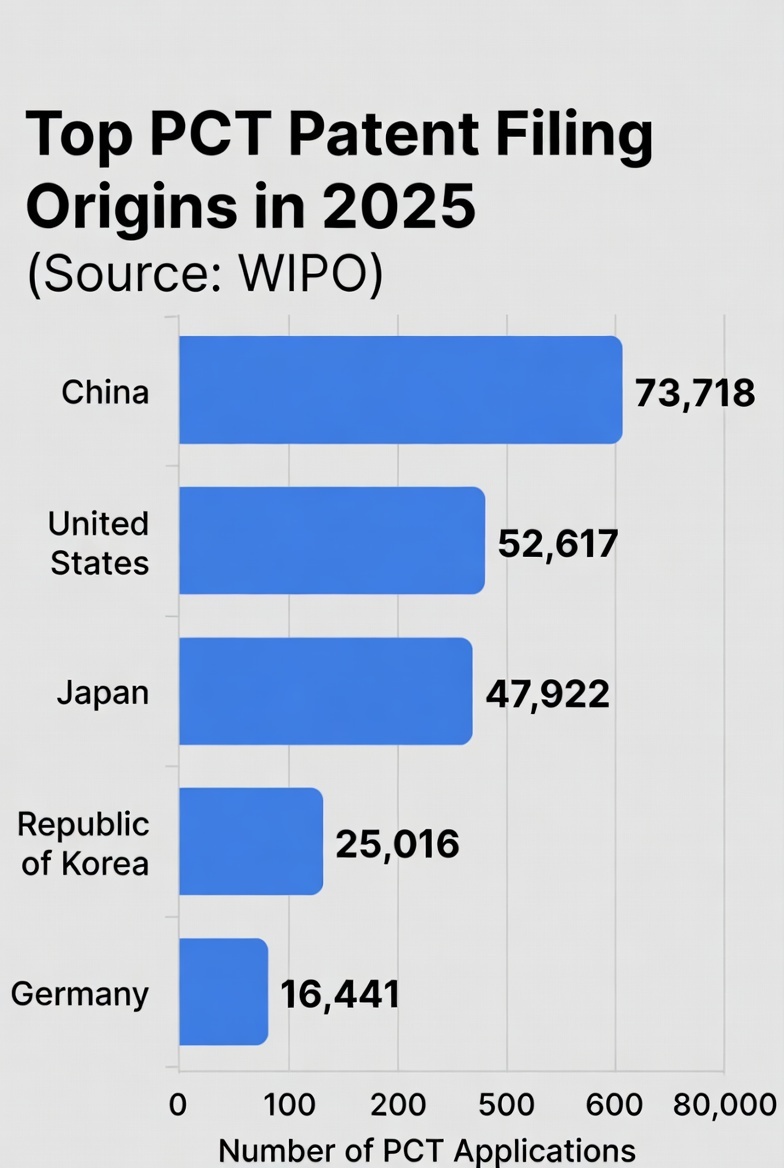
The sheer volume of international filings only raises the pressure. WIPO recorded roughly 275,900 PCT international applications in 2025, continuing a modest upward trend. China led the origins with 73,718 filings, followed by the United States at 52,617 and Japan at 47,922. National-phase entries from earlier years hovered around 698,500. Every single one of those applications that crosses borders needs flawless translations tailored to each office’s quirks.
Speed matters, but only if accuracy comes first. Competent teams turn around certified translations in a matter of days—not weeks—while keeping technical experts on hand to double-check every term against the latest office guidelines. They catch missing antecedents, fix enablement gaps, and make sure figure references line up perfectly across languages. Machine translation tools still miss these details regularly, which is why experienced human review remains non-negotiable.
The payoff shows up fast: fewer office actions, smoother prosecution, and patents that actually deliver the broad protection the inventor intended. Companies that treat translation as a strategic step rather than an afterthought end up safeguarding their freedom to operate and their ability to license or enforce rights worldwide.
When the margin for error sits at zero, you need partners who live at the intersection of cutting-edge technology, international patent law, and precise linguistics. Artlangs Translation delivers exactly that combination. They handle more than 230 languages and have spent years sharpening their focus on translation services, video localization, short-drama subtitle localization, game localization, multilingual dubbing for short dramas and audiobooks, plus multilingual data annotation and transcription. Their portfolio of successful global patent filings speaks for itself—translations that don’t just meet deadlines but actually strengthen the original invention’s legal scope. For inventors who refuse to leave their life’s work to chance, that depth of specialized experience is the safest way forward.