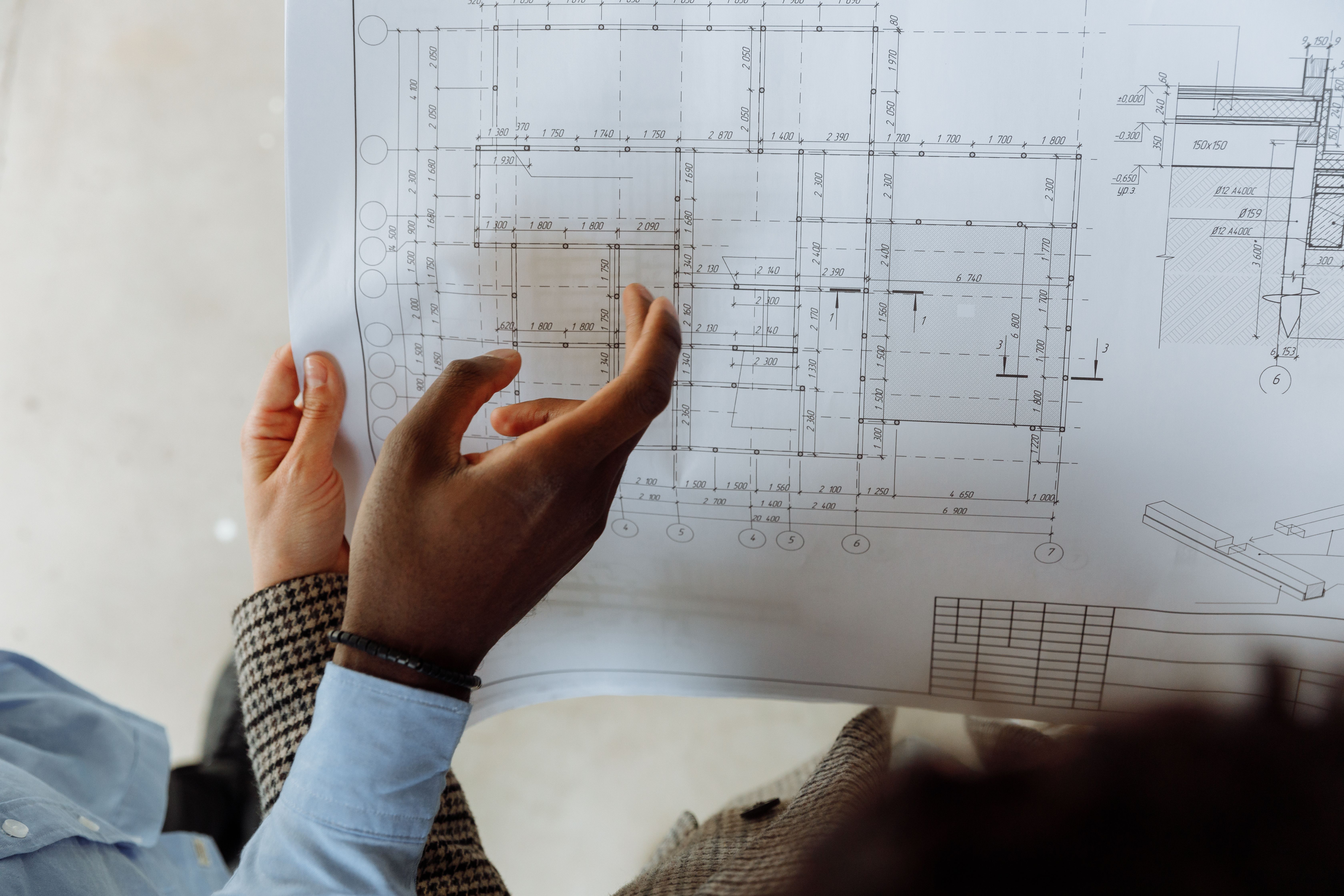
Mechanical patents live or die on the drawings. A single exploded view of a CNC spindle or an automotive suspension linkage can contain dozens of parts, each with reference numerals, dimension lines, and callouts that must match the claims and description exactly. When those documents move across languages, the spatial language that describes how the parts sit relative to one another becomes the most common failure point.
Terms such as “along the axial direction,” “radially inward,” “relatively fixed,” or “disposed opposite the mounting face” look deceptively simple. In practice they define degrees of freedom, load paths, and the precise kinematic sequence that the invention claims. A translator who treats them as ordinary prepositions can flip a constrained joint into a free one, or turn a clearance fit into an interference fit. Examiners notice. Competitors notice later, when the patent is asserted or challenged.
A Steinbeis Institute survey of intellectual-property professionals found that 81 percent had encountered translation errors in patent documents. More than a quarter of those errors caused serious damage to the scope of protection; 58 percent viewed such mistakes as a latent risk hanging over entire portfolios. The market for specialized patent translation itself continues to expand, projected to grow from roughly USD 193 million in 2024 to USD 353 million by 2032. The growth reflects rising cross-border filings, yet accuracy remains uneven precisely because mechanical subject matter demands more than linguistic fluency.
Consider a four-bar linkage in a robotic end-effector or a vehicle transmission. The description must preserve the exact sequence of pivots, sliding joints, and fixed points. Shift the wording of one “relatively fixed” connection and the claimed motion path changes. The same risk appears with geometric dimensioning and tolerancing. ISO GPS and ASME Y14.5 share many symbols, yet they differ in default envelope requirements and independence principles. An H7/g6 fit rendered loosely can alter manufacturing feasibility and interchangeability in the eyes of an examiner who knows the standards by heart.
Real cases show how small choices compound. In European proceedings involving an early electronic-cigarette vaporizer patent that originated in Chinese, the rendering of a term for multiple openings shifted between “perforated” and “porous.” Opponents successfully argued that the change introduced added matter. Another documented instance turned on “median particle diameter” becoming “average particle diameter”; the difference was enough for the Russian Patent Office to accept a novelty challenge and revoke the patent. Similar problems have arisen with “circular” versus “round,” and with German-to-English translations that left claim language indefinite enough to force narrowing during prosecution.
Automotive engineering patents and CNC machine-tool filings amplify these difficulties. Suspension systems, steering linkages, and multi-axis machining centers generate dense drawings with nested assemblies. Chinese-origin applications often use directional phrases that depend on the viewing plane of the figure; without constant cross-reference between text and drawing, “inward” can reverse relative to the reader’s perspective. Reference numerals must remain consistent across every language version. A mismatch triggers clarity objections at the EPO, USPTO, or CNIPA and can delay grant by months.
The practical solution is not more generalist translators. It is linguists who already understand mechanical drawing conventions, kinematic chains, and the difference between a rigid connection and constrained motion under load. They build project glossaries early, verify every callout against the figures, and flag ambiguities before the text is finalized. Machine translation can accelerate first drafts, but the spatial and tolerancing layers still require human engineering judgment. Office actions multiply when that judgment is missing; one analysis of prosecution outcomes noted that machine-translated filings generated substantially more examiner queries than carefully human-translated equivalents.
For companies filing or enforcing mechanical patents globally, the cost of getting the spatial language wrong is rarely limited to refiling fees. It appears later as narrowed claims, invalidated rights, or lost commercial exclusivity. The drawings themselves are not decorative; they form part of the enabling disclosure. Treating the orientation words and fit specifications with the same care given to claim transitions is what keeps the protection intact when the patent is tested.
Artlangs Translation has spent more than two decades refining exactly this kind of specialized work. With coverage across more than 230 languages, a network of over 20,000 professional partner translators, and a long record of mechanical, automotive, and industrial patent projects, the company combines technical depth with consistent quality control. Its broader service range—covering video localization, short-drama subtitle localization, game localization, multilingual dubbing for short dramas and audiobooks, and multilingual data annotation and transcription—means the same rigorous processes applied to patent drawings are available for related technical and multimedia content. The result is documentation that examiners can read without ambiguity and that holds its intended scope when challenged.