In the fast-paced world of artificial intelligence, securing intellectual property demands flawless AI Technology Patent Translation to navigate international filings successfully. With innovations evolving rapidly, even minor inaccuracies in translating complex technical descriptions can lead to rejected applications or weakened protection. Specialized translation ensures your AI breakthroughs reach global markets intact, turning potential headaches into competitive advantages.
The Unique Challenges of AI Technology Patents
AI patents stand apart from traditional inventions due to their rapid technical iteration and intricate detail. Descriptions often span thousands of words, blending computer science, mathematics, and domain-specific applications like neural networks or generative models. Terminology must be translated with absolute precision—terms like “transformer architecture” or “adversarial training” carry legal weight that generic tools or non-specialists can easily misinterpret.
The pace of innovation compounds the issue. Competitors file similar claims within months, so delays from poor translations risk losing priority. Patent documents also include equations, flowcharts, and pseudocode that demand not just linguistic accuracy but technical fidelity across languages. According to WIPO data, AI-related inventions now form a growing share of global filings, with PCT international applications reaching 275,900 in 2025 and digital technologies—fueled by AI—driving much of the growth. OECD analysis shows AI patents accounted for about 6% of all PCT filings by 2023, three times the 2015 level, led by China (31%), the US (27%), and Japan (10.5%).
This complexity creates real pain points: exploding translation costs for multi-country layouts and the risk of office actions or outright rejections when nuances get lost.
Global Patent Filing Requirements: What Major Jurisdictions Demand
Successful global protection hinges on meeting strict language and procedural rules in key markets. The Patent Cooperation Treaty (PCT), administered by WIPO, streamlines the initial phase by allowing a single international application that buys 30–31 months to decide on national entries. Yet national and regional offices impose their own translation mandates.
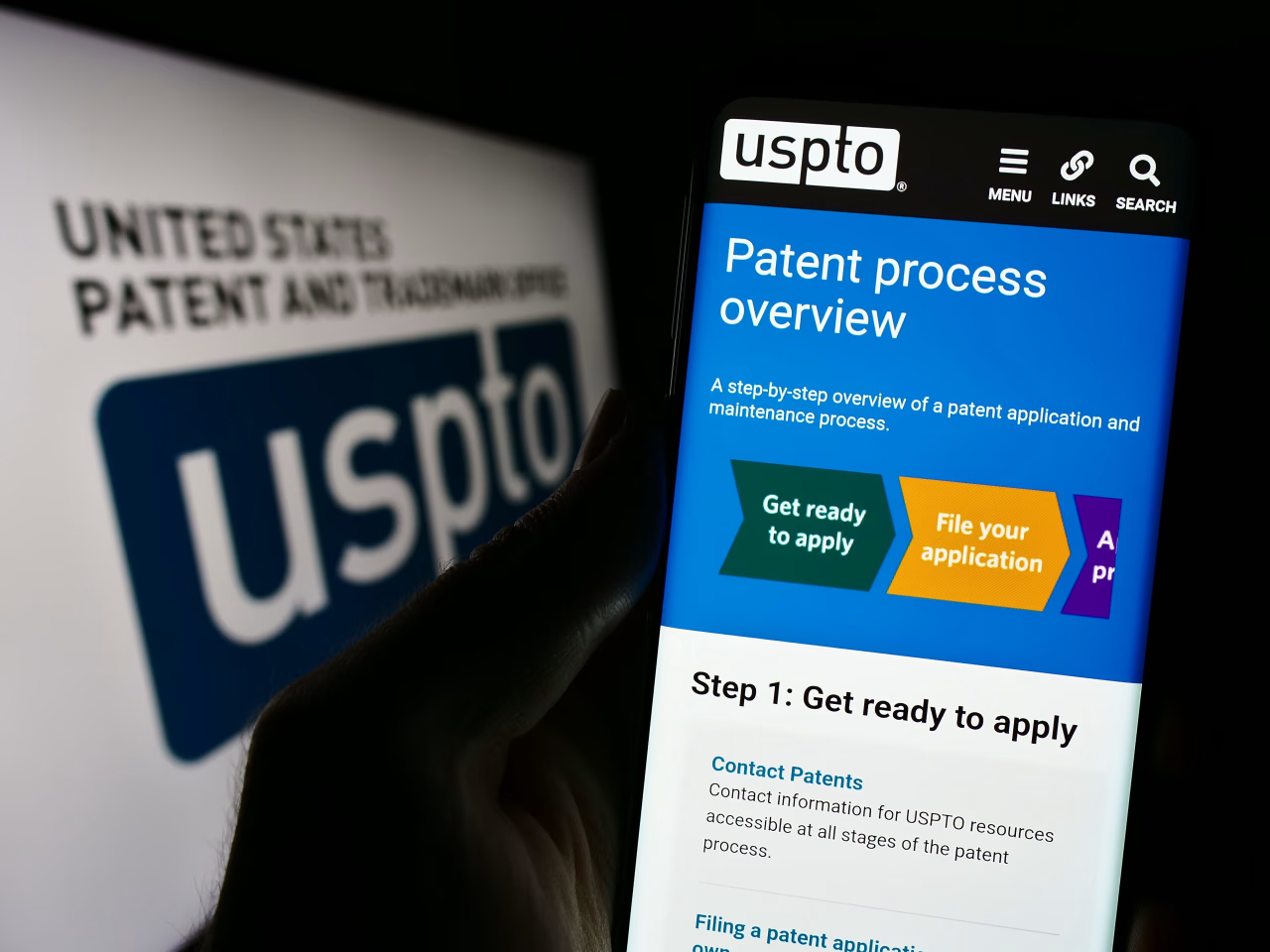
United States (USPTO): English is the primary language for most filings, but AI inventions must satisfy updated subject-matter eligibility guidelines emphasizing practical applications. Recent USPTO guidance clarifies that human inventorship remains essential even with AI assistance.
European Patent Office (EPO): Applications may be filed in English, French, or German, but validation in member states often requires additional translations.
China (CNIPA): Full Chinese translation is mandatory for national phase entry.
Japan (JPO): Japanese translation is required within tight timelines.
The International Patent Classification (IPC) system further underscores the technical specificity needed. Here’s a snapshot of core IPC codes frequently assigned to AI patents:
| IPC Code | Description | Relevance to AI Technology Patents |
|---|---|---|
| G06N 3/00 | Computing arrangements based on biological models | Neural networks, deep learning architectures |
| G06N 20/00 | Machine learning | Core algorithms, training methods, model optimization |
| G06N 5/00 | Knowledge-based models | Expert systems, reasoning engines |
| G06F 18/00 | Pattern recognition, data processing | Computer vision, natural language processing |
| G06N 7/00 | Mathematical models | Probabilistic and statistical AI techniques |
Accurate translation must preserve these classifications and supporting claims to avoid reclassification or invalidation.
Global AI Patent Filing Flowchart (Simplified Process)
Priority Filing – Submit in home country (e.g., USPTO) to establish date.
PCT International Application – File within 12 months via WIPO for 150+ countries.
International Search & Opinion – Receive WIPO report on patentability.
National/Regional Phase Entry (30–31 months) – Translate into local languages, pay fees, and submit to target offices (USPTO, EPO, CNIPA, JPO, etc.).
National Examination & Grant – Prosecute locally; respond to office actions with precise amendments.
Missing any translation deadline resets the clock permanently in that jurisdiction—costly and irreversible.
Artlangs End-to-End Service: Precision from Start to Finish
Artlangs delivers a seamless, expert-driven process tailored to AI patent needs. Native linguists with advanced degrees in computer science and intellectual property review every term against the latest technical literature and legal precedents. Services cover full translation of specifications, claims, abstracts, and drawings, plus certified proofreading and formatting for direct submission.
Beyond text, Artlangs supports ancillary materials—such as technical diagrams or data annotations—that often accompany AI filings. Their workflow includes pre-filing glossaries, iterative client reviews, and post-filing support for office actions. This end-to-end approach eliminates the fragmented vendor handoffs that inflate costs and introduce errors.
Calculating ROI: Why Precision Pays for Itself
Let’s run the numbers. A typical 15,000-word AI patent translated for five major jurisdictions at $0.20 per word averages $15,000–$25,000 in professional fees—far less than the $50,000+ in lost opportunity from a single rejected filing or delayed market entry.
Poor translations trigger extra office actions, extending prosecution by 12–24 months and adding legal fees. In contrast, flawless work accelerates grants, enabling earlier licensing or enforcement. One granted AI patent in key markets can generate millions in protected revenue through exclusivity. Factor in maintenance fees and you see clear ROI: professional translation typically delivers payback within the first year of commercialization.
Businesses choosing generic or machine-only services face hidden costs—re-filings, narrowed claims, or abandoned markets. Artlangs clients avoid these pitfalls, securing broader protection faster and at lower total cost.
When your AI innovation is ready for the world, partner with a provider that treats every word as intellectual capital. Artlangs Translation brings mastery of over 230 languages and years of focused expertise in translation services, video localization, short drama subtitle localization, game localization, short dramas and audiobooks with multilingual dubbing, plus multilingual data annotation and transcription. With a track record of excellent cases and deep industry experience, they turn complex patent challenges into protected global success stories. Your next filing deserves nothing less.