
Patents coming out of Japan and South Korea keep reshaping entire industries — from cutting-edge semiconductors and electric vehicle batteries to next-level biotech tools. The problem is, when those inventions head overseas, every single technical detail has to cross languages without losing even a fraction of its meaning. Miss one nuance and the whole protection can fall apart in a foreign market.
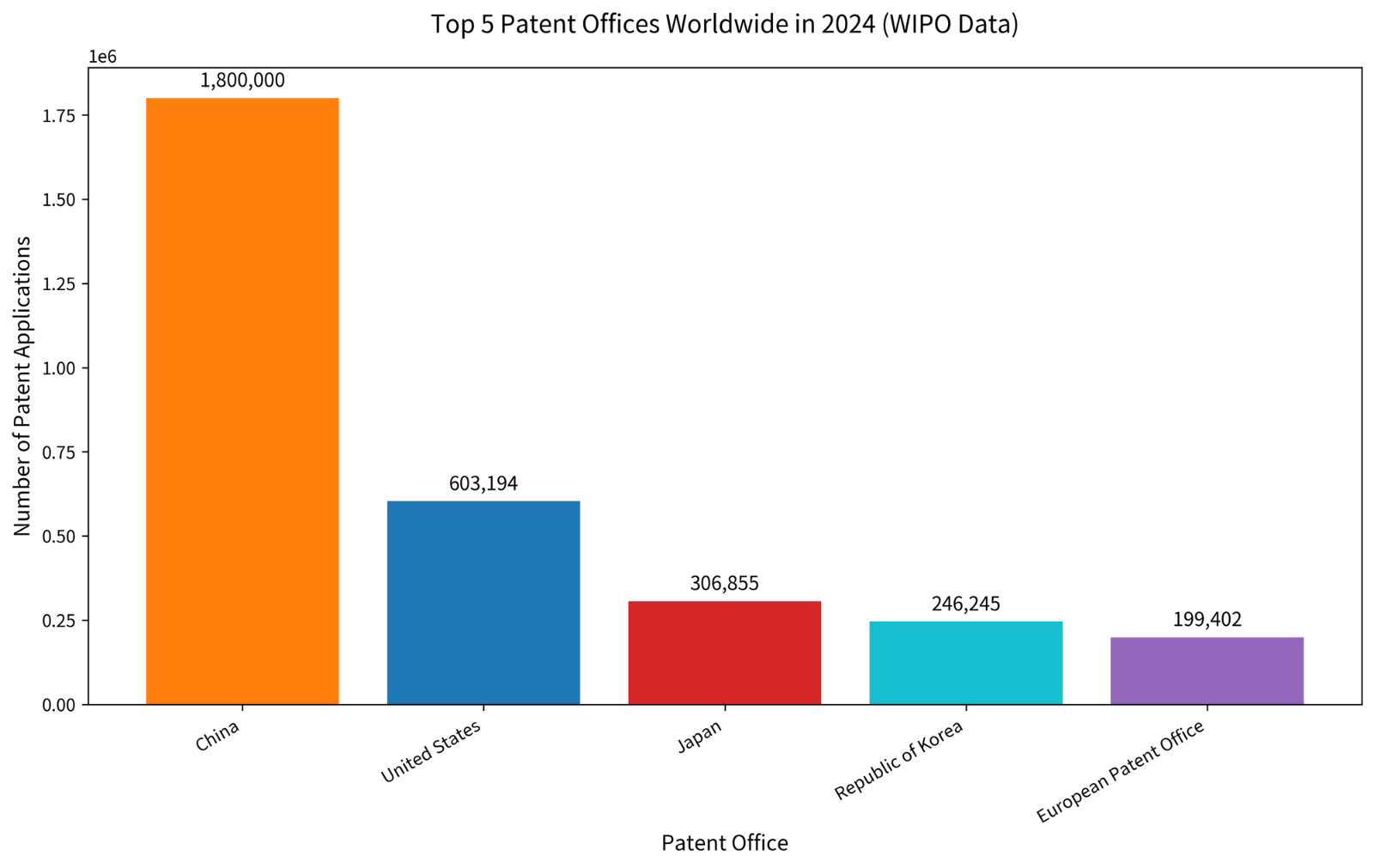
The latest WIPO numbers make the scale impossible to ignore. In 2024, the Japan Patent Office handled 306,855 applications while South Korea’s KIPO processed 246,245. Together with China and the US, these top offices made up 85.5 % of the world’s 3.7 million filings. That volume isn’t just impressive — it means thousands of high-stakes documents need flawless translation every year if companies want their IP to hold up internationally.
The real headache starts with how Japanese and Korean actually work. Japanese patents love topic-comment structures and often drop the subject entirely because context is supposed to carry it. One kanji compound can flip meanings depending on the exact engineering field you’re in. Korean stacks suffixes that change tense, condition, and legal weight in ways that feel almost invisible to outsiders. A phrase that clearly means “only if the previous step is complete” in the original can suddenly read like an optional extra in English if the translator doesn’t live and breathe both the language and the technology.
I remember one Korean display-tech patent that came across our desk last year. The original wording used a layered conditional construction that locked the manufacturing steps into a strict sequence — something any native engineer would catch instantly. A standard translation engine turned it vague enough that an examiner could have narrowed the claim or invited a competitor to argue around it. Our translator, a native Korean speaker with an electrical engineering background, rewrote the English claims so the intent stayed crystal clear. The patent sailed through examination with zero amendments. Cases like that happen more often than people admit, and they’re exactly why generic services or pure machine translation create real risk.
That’s why the only safe route is native linguists who also have serious technical credentials. These specialists don’t just swap words — they rebuild the inventor’s logic so it lands exactly the same way in the target jurisdiction. They lock terminology across the entire specification, claims, and drawings. They spot the phrasing that will raise red flags with foreign examiners. And they deliver translations that actually stand up when it matters — in opposition proceedings, licensing talks, or court.
The payoff shows up fast. Translation for a typical Japanese or Korean patent usually runs between $3,000 and $6,500, but that’s still far cheaper than the litigation or re-filing costs that follow a sloppy version. Accurate work also means fewer office actions, quicker grants, and IP that genuinely protects market position instead of just sitting on paper.
When companies need Japanese patent translation or Korean patent translation that removes the guesswork, the choice comes down to teams built for exactly this kind of precision. For anyone wrestling with 日韩专利翻译 demands or moving innovations out of Asia, Artlangs Translation has quietly become the go-to partner. They bring fluency in more than 230 languages and years of hands-on focus in translation services, video localization, short drama subtitle localization, game localization, multilingual dubbing for short dramas and audiobooks, plus multilingual data annotation and transcription. Their portfolio of successful projects speaks louder than any sales pitch — turning complex patent work into ironclad protections that let innovators stay ahead, wherever their ideas travel next.