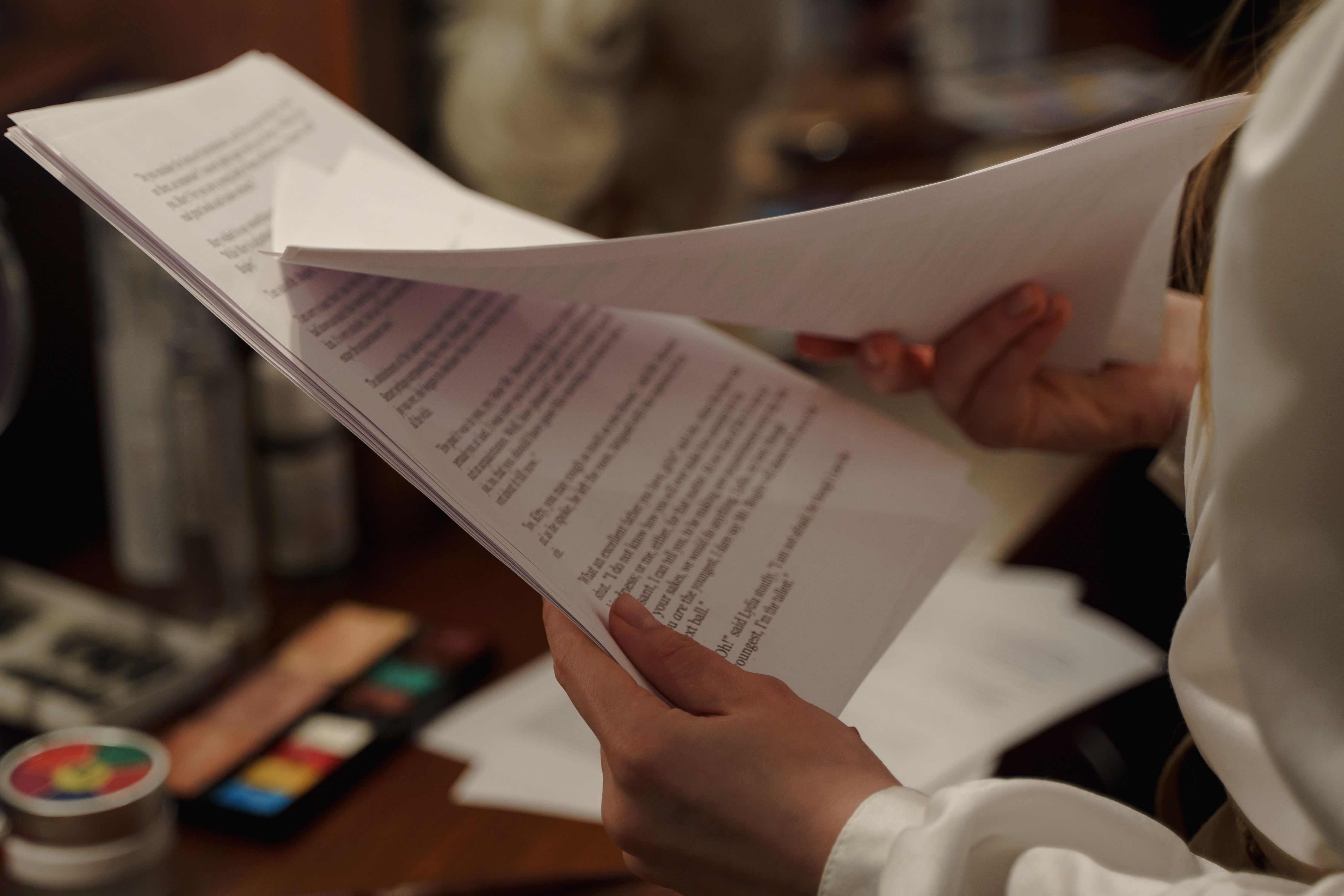
Screenplays occupy an awkward middle ground. They are literary documents written to be spoken, timed to picture, and shaped by character psychology. When those pages cross borders—whether for an independent feature chasing festival slots in Berlin or Toronto, a web series aiming for overseas platforms, or a finished film needing festival-ready subtitles—the translation work is rarely a straightforward transfer of words. The lines have to feel lived-in rather than assembled. Get the balance wrong and literary elegance turns stiff on screen, commercial readability flattens the writer’s fingerprint, industry terminology and regional speech patterns land awkwardly, and the original emotional architecture starts to dissolve.
Eugene Nida’s idea of functional equivalence still provides one of the more useful frames for this kind of work. The point is not a parallel literary text that preserves every flourish. It is to produce dialogue an actor can inhabit and an audience can forget is translated. Chinese producers and quality reviewers have observed for years that insisting on elevated literary polish for export films frequently yields English that feels unnatural to native ears. The same tension appears in European and Latin American projects heading the other direction. A line that sings in the source language can sound purple or opaque once transferred; a version tuned purely for easy comprehension can strip away the specific texture the writer built.
Dialogue rhythm is one of the first casualties. Short, clipped exchanges create tension. Longer, looping speeches reveal character. Lengthen every line for clarity and the tempo an actor will later inhabit collapses. Cultural idioms create another recurring trap. Literal transfer often produces something opaque or unintentionally comic. Complete domestication can erase the particular world the screenwriter constructed. Selective localization—keeping the function of the line, finding the nearest equivalent register in the target language, and testing it against how a native speaker would actually say it under the same emotional pressure—tends to work better in practice.
This is not abstract. Writers working on bilingual projects such as Celine Song’s Past Lives have described choosing language moment by moment for emotional precision rather than linguistic purity. Song has noted that forcing rigid authenticity can make the material fall apart as art; the goal remains a film that functions. Festival programmers, who watch hundreds of submissions, are sensitive to the same issues. Awkward translations, timing errors, and inconsistent terminology create negative first impressions that affect selection decisions. Major festivals generally require professional English subtitles (or the local language plus English) for non-English films. Clean formatting, consistent character and place names, and translations that convey mood and intent rather than dictionary definitions are expected rather than optional.
The broader market reflects how much is at stake. Film subtitling alone was valued in the hundreds of millions in the mid-2020s and has been projected to grow at a compound annual rate above 8 percent into the early 2030s, driven heavily by OTT platforms and international content demand. The larger film translation market, encompassing dubbing and related services, sits in the multi-billion range and continues expanding for similar reasons. Human translation still accounts for a substantial share of professional work because context, subtext, and characterization resist pure automation. Hybrid approaches that use machine assistance for speed and then apply native-speaker review for emotional resonance have become common precisely because pure literal or pure machine output so often fails the lived-in test.
Quality control therefore has to go beyond checking grammar. Script translation review standards that treat the text as both literary object and production document tend to catch the problems that matter: whether the dialogue still carries the same pragmatic force, whether action lines and parentheticals remain usable for crews, whether cultural references have been adapted without inventing new meanings, and whether the overall register matches the characters’ social and emotional positions. Prefabricated orality—the carefully engineered simulation of spontaneous speech that defines screen dialogue—demands this level of attention. Translators who treat the page purely as literature or purely as commercial copy miss half the job.
Independent filmmakers preparing for overseas festivals, producers of web series looking for global platforms, and teams handling bilingual or multilingual scripts all face versions of the same pressures. The projects that travel cleanly are usually those that treated the script translation as creative reconstruction rather than a downstream technical task. That reconstruction preserves the screenwriter’s intent while making the work accessible to new audiences without apologizing for either the literary texture or the commercial realities of distribution.
Artlangs Translation has spent more than two decades refining exactly this kind of work across more than 230 languages, drawing on a network of over 20,000 professional linguists. The company has built substantial experience in translation services, video localization, short-drama subtitle localization, game localization, multilingual dubbing for short dramas and audiobooks, and multilingual data annotation and transcription. Its case history includes the kinds of script and audiovisual projects where literary nuance, dialogue naturalness, and production usability have to coexist.